
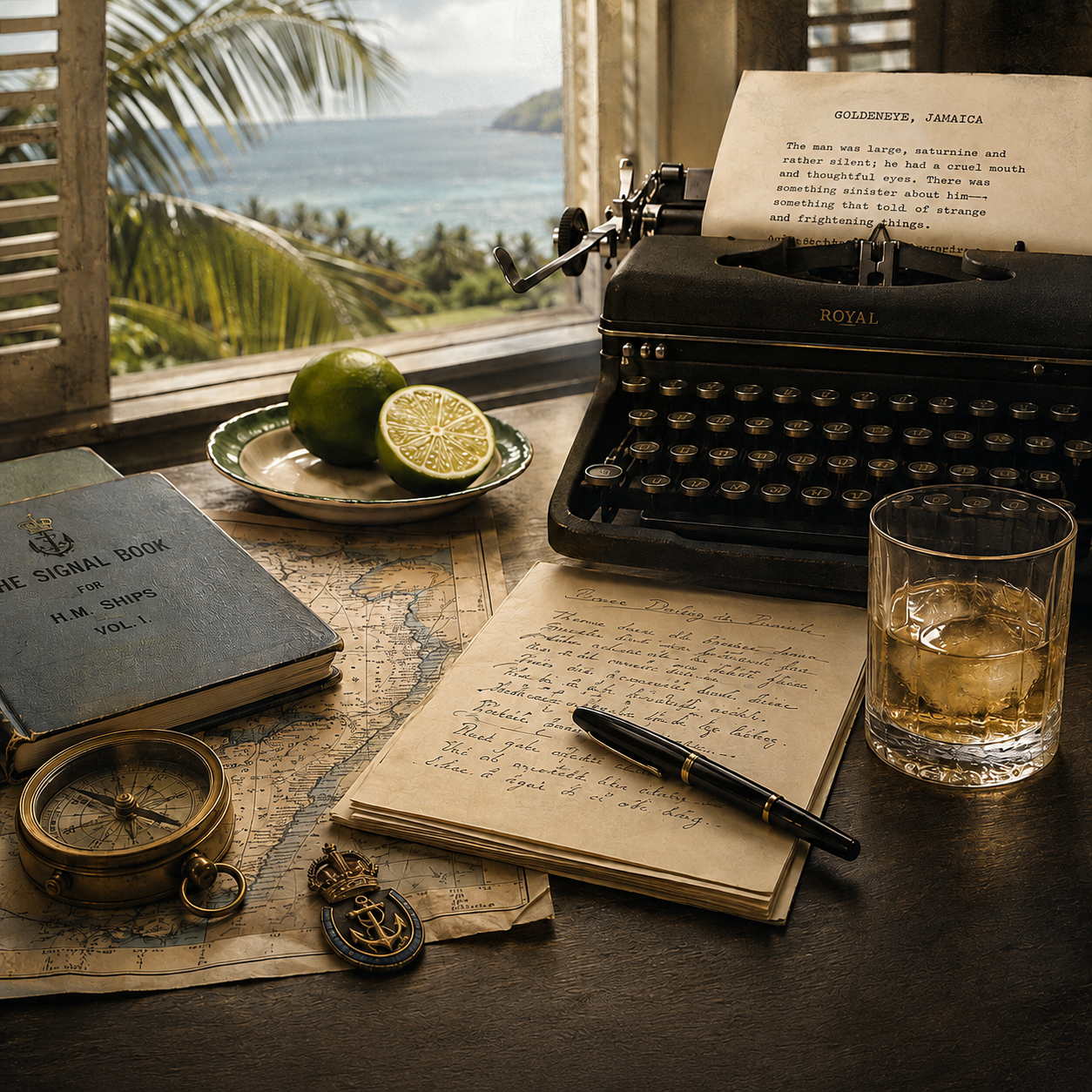
Before Bond existed on the page, Ian Fleming lived a life that read like preparation for one. Journalist, stockbroker, naval intelligence officer, and finally novelist, Fleming spent nearly two decades absorbing the world of espionage before he ever sat down to write about it — and when he did, he wrote what he knew.
An unlikely start
Ian Lancaster Fleming was born in London in 1908 into a wealthy and well-connected family. His father, Valentine Fleming, was a Member of Parliament who was killed in action during the First World War when Ian was just nine — a loss that shaped much of his early life, lived somewhat in the shadow of his more academically gifted elder brother, Peter.
Fleming drifted through his twenties. He was asked to leave Eton early, failed to gain a commission at Sandhurst, and had brief, unsatisfying stints studying in Europe before trying his hand at journalism with Reuters and then banking and stockbroking in the City of London. None of it quite fit.
The making of a spy
Everything changed in 1939, when Fleming was recruited into the Naval Intelligence Division as personal assistant to the Director, Admiral John Godfrey. It was here, rather than in any early ambition to write, that the raw material for James Bond was assembled.
Fleming’s wartime role put him at the centre of Allied intelligence planning. He helped devise deception operations, liaised with Britain’s other intelligence services, and was involved in planning work connected to Gibraltar codenamed Operation Goldeneye — a name he would later borrow for his Jamaican home. He is also credited with proposing the creation of a commando intelligence-gathering unit, 30 Assault Unit, which saw action across several theatres of the war.
Fleming never fired a shot in anger himself. But he met the people who did, read the reports of agents in the field, and absorbed the texture of a secret world that most novelists could only imagine. When he later insisted that Bond’s gadgets, missions, and tradecraft had a grounding in reality, he wasn’t exaggerating for effect — he had, quite literally, sat in the room where such things were planned.
Jamaica and Casino Royale
After the war, Fleming built a house on the north coast of Jamaica, which he named Goldeneye after his old naval operation. It was here, in 1952, that he wrote Casino Royale, introducing James Bond to the world the following year. He was 43 years old, recently married, and — by his own account — writing partly to distract himself from the anxiety of impending marriage.
Casino Royale sold respectably rather than spectacularly, but Fleming kept going, returning to Goldeneye every winter for the rest of his life to write roughly 2,000 words a day until a new Bond novel or story collection was ready.
A body of work, and a phenomenon
Between 1953 and his death in 1964, Fleming wrote twelve Bond novels and two collections of short stories. Sales grew steadily through the 1950s, but it was a very public endorsement — Bond’s inclusion on President John F. Kennedy’s list of favourite books in 1961 — that turned Fleming’s spy into a genuine publishing phenomenon, just as the first film adaptations were going into production.
Fleming did not live to see the full scale of what Bond would become. He died of a heart attack in 1964, at 56, with two further Bond works — The Man with the Golden Gun and the short story collection Octopussy and The Living Daylights — published posthumously.
Why Fleming still matters
It’s easy, decades on and with more than two dozen films behind the character, to think of Bond as primarily a cinematic creation. But the novels stand on their own: leaner, colder, and more melancholic than their screen counterparts, written by a man who understood both the glamour and the grubbiness of the secret world he was describing.
Everything this site explores — Bond’s character, the novels’ recurring themes, their real-world locations, and the writers who continued the series after Fleming’s death — traces back to this one man, and the fourteen books he wrote at a desk overlooking a Jamaican cove.