
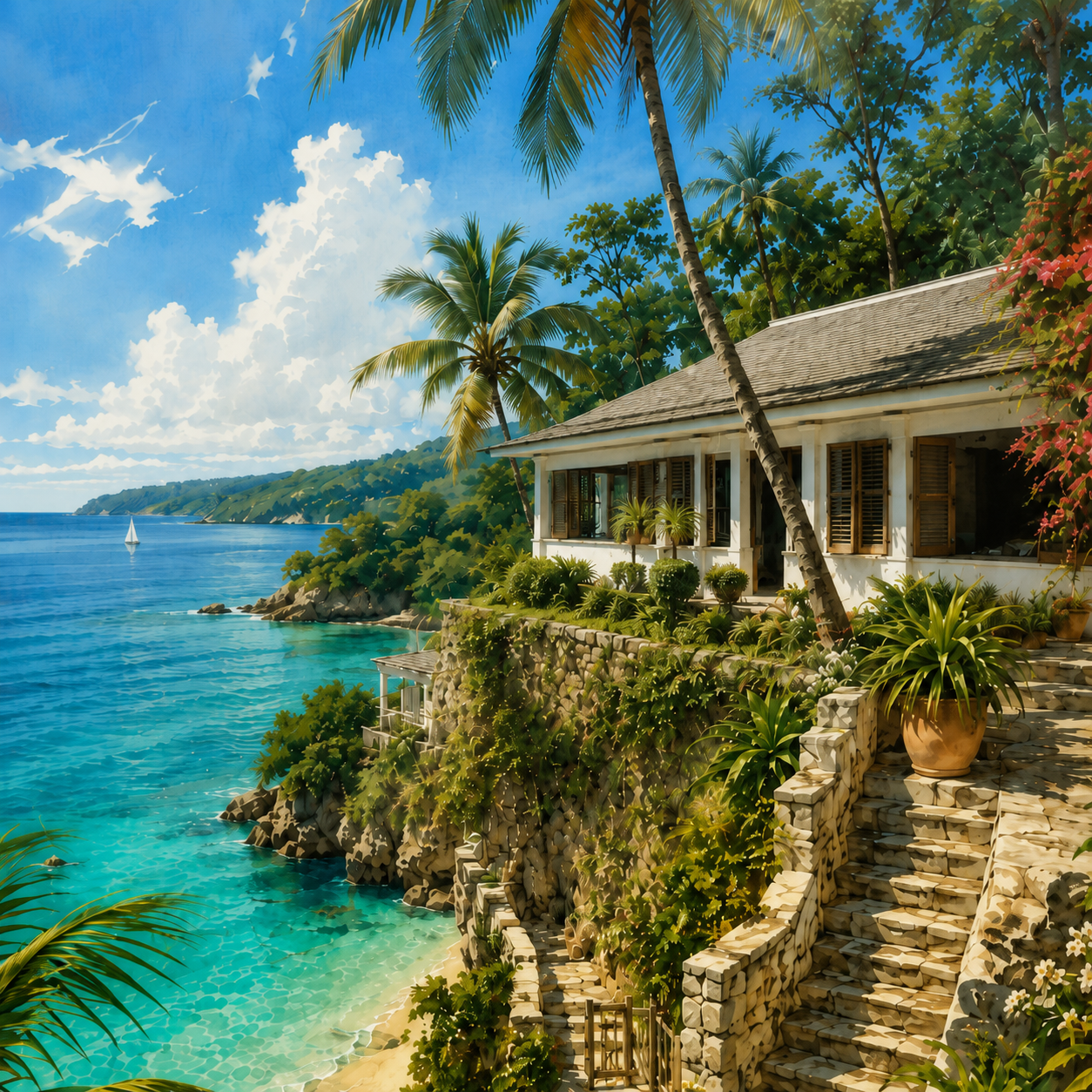
Every one of Ian Fleming’s Bond novels and short stories was written in the same room, at the same desk, in the same house on the north coast of Jamaica. If there’s a single physical place behind the entire Bond phenomenon, it’s Goldeneye.
From donkey track to writer’s retreat
Fleming first came to Jamaica in 1943, on naval intelligence business during the war, and fell for the island immediately. In 1946, he bought fifteen acres of land at Oracabessa, on Jamaica’s north coast — the site of a former donkey racetrack, overlooking a small private cove — and designed a house for it himself, with no architectural training and, by most accounts, no shortage of self-confidence.
He named it Goldeneye, after a wartime naval operation he had worked on. It was a deliberately plain, functional building for a man who could easily have afforded something grander: a modest three- or four-bedroom villa with no glass in the windows, just traditional Jamaican jalousie shutters to let in the sea air. Fleming wanted somewhere to write, swim, and think, not somewhere to entertain in style.
A room with a routine
From 1946 until his death in 1964, Fleming spent two months of most years at Goldeneye, and it was here, starting in 1952, that he began writing Casino Royale. He kept a strict routine: mornings at his writing desk producing around 2,000 words, afternoons swimming and snorkelling in the cove below the house, evenings for company and cocktails. Every one of the fourteen Bond books was written this way, in this room, before Fleming took the manuscript back to London to be typed up and edited.
Three of the novels — Dr. No, Live and Let Die, and The Man with the Golden Gun — are set at least partly in Jamaica itself, drawing directly on the landscape Fleming could see from his own terrace.
A social hub, almost by accident
Goldeneye also became something of a gathering point. Fleming’s neighbour was the playwright Noël Coward, who first rented Goldeneye himself before building his own nearby retreat, Firefly, and the two remained close friends. Over the years, Fleming’s Jamaican circle extended to a striking range of literary, political, and social figures, drawn as much by the island as by Fleming himself.
What it left behind
Fleming died in 1964, and Goldeneye passed out of his family’s hands not long after. The house still stands today, part of a resort built around the original property, with Fleming’s writing desk preserved in what’s now known as the Fleming Villa.
It’s a small, unassuming building for something so consequential. But it’s genuinely difficult to separate James Bond from the room he was written in — a plain, windowless house on a Jamaican headland, built by a man who once said he doubted the books would have existed at all without it.